The enterprise AI debate has settled into two camps. One says the fix is more deployment: more seats, more agents, more workflows. The other says the technology was oversold and points to the flat earnings numbers as proof. Both camps are arguing about the tool. The more useful observation is about the company the tool is landing in, because every enterprise past a certain scale runs as two versions of itself, and AI is landing in both at once.
Irina Wolpert gave those two versions their best recent description in Harvard Business Review. Every organization past a certain scale, she argues, runs as a reported organization, the one that exists in dashboards, board materials, and analyst calls, and a lived organization, the one employees actually experience. Her opening scene is a CEO presenting an AI transformation to the board on impeccable slides, twenty-four hours after Wolpert sat with the engineers who built those tools and learned that two of the most senior were already looking for new roles.
The split is not a modern corporate disease. James C. Scott spent a career documenting how states impose "administrative legibility" on societies: standardized, simplified, aggregated views that make governing possible and leave the center "blind to the complex interactions" underneath. Hayek made the mirror-image point about markets, that the knowledge which matters exists only in dispersed fragments no central planner can hold. Enterprises did not invent the gap between the summarized world and the executed one. They inherited it, which is why decades of transparency initiatives and reporting systems have moved it so little.
The gap persists because everyone inside it is behaving sensibly. A chief executive accountable for thousands can directly observe perhaps a dozen people; at that span, governing through representation is not a preference, it is arithmetic. The representations are compressed at every layer by people with stakes in the compression, which is not corruption, just what happens when the record of work is authored by the people the record describes. Meanwhile the frontline holds the truth, but in fragments; each person knows the sliver they touch, and the whole lived company exists in no one's head. And the record, however polished, is the only thing leadership can defensibly act on, because boards and auditors do not move capital on hallway knowledge. Rational summarizers, rational concealers, rational governors. The aggregate is a company that cannot quite see itself.
Then AI arrived on both sides of the gap at once.
Below, the gains are real. The individual productivity effects are about as well-documented as anything in workplace research, and they arrive as found time, scattered across thousands of desks. But a saved hour becomes enterprise value only when someone re-scopes a role or redeploys the capacity, and that requires the hour to become visible to someone with authority, which mostly it does not. Announcing a surplus is how targets move and teams shrink, so surpluses stay quiet. This is how a large majority of enterprises can keep telling surveyors they see no tangible earnings impact from generative AI while nearly every desk beneath them runs faster.
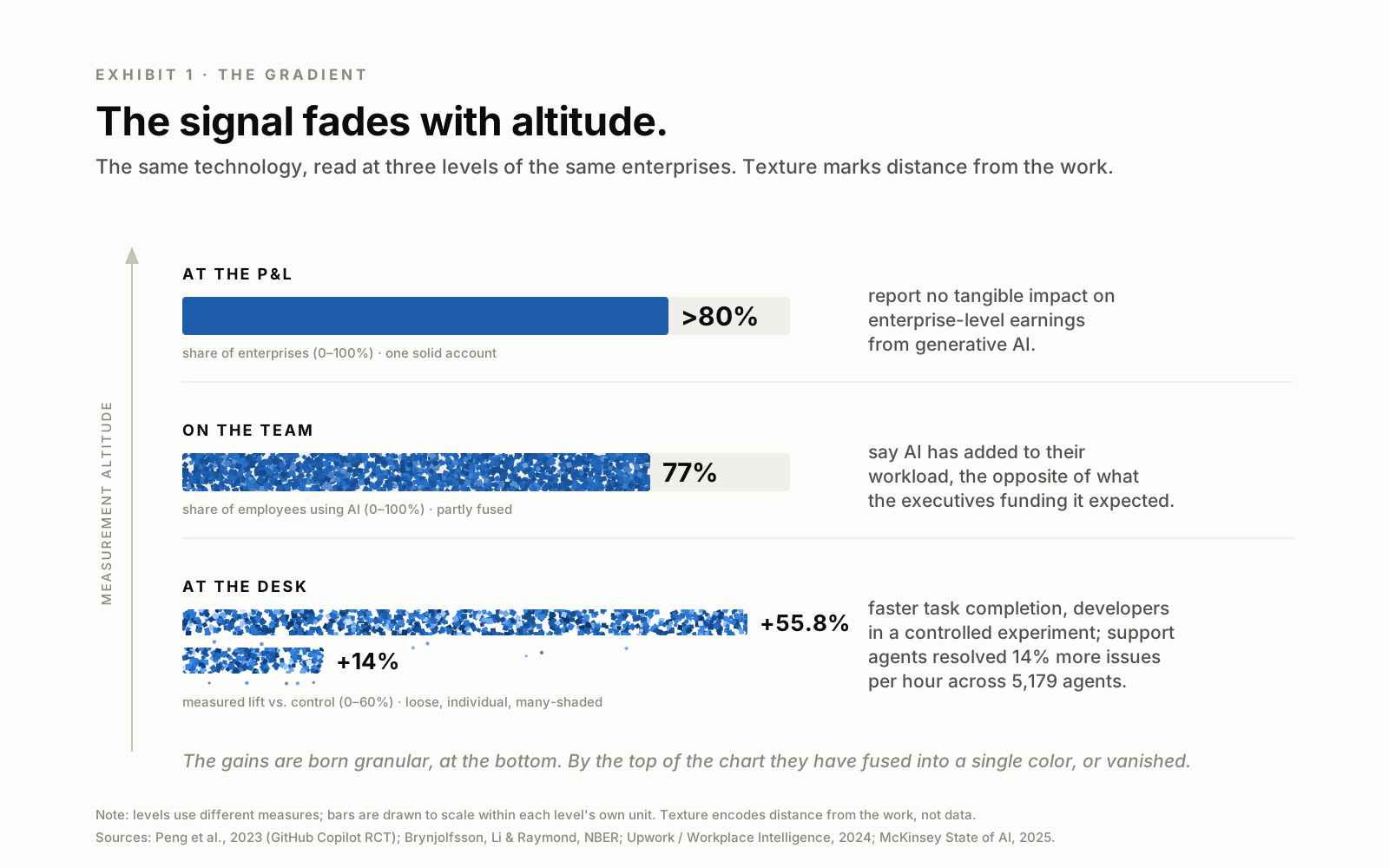
Above, AI is doing something quieter and more consequential: it is industrializing the reported organization. The board deck is now drafted by an AI assistant working from a prompt shaped by what the executive team wants to hear. The rough drafts and hallway caveats that used to leak reality upward are filtered out before any human reads them. Wolpert's assessment of what arrives is exact: "more coherent and more authoritative than any prior version. Whether it is more accurate is a question almost no one is asking."
So the default trajectory is worth stating plainly. Left alone, AI makes the lived company more productive and the reported company more persuasive, simultaneously, while nothing new connects them. The gap does not close. It widens, wearing better production values.
That is not the whole story, though, and the history of enterprise software supplies the distinction that matters more than any adoption metric. Every record a company has ever governed by has been an authored record: testimony about work, keyed into forms, written into status updates, assembled into decks. Authored records are curated by definition, because authorship is exactly where the incentives operate. This is why every previous technology that promised to close the visibility gap was absorbed by it instead. ERP promised a single source of truth and delivered, in the memorable case of Mission Produce, a $22 million hit to a single quarter's gross profit during which the company could no longer tell how many avocados it had on hand, or how ripe they were. The system faithfully aggregated what people typed. What people typed was the reported organization.
An assembled record is a different object. Process mining, a category that predates the current AI wave, demonstrated two things the enterprise has not fully absorbed: that the actual process, computed from event logs, reliably differs from the documented process gathered in workshops and interviews, and that machines can read the actual one. AI generalizes that capability from structured logs toward work itself. For the first time, it is technically possible for the record to be computed from the work rather than authored about it. That does not end curation. Someone still decides which streams get assembled, what counts as signal, and how the picture is summarized for the room, and that someone has stakes; the deck about the event logs is still a deck. What assembly breaks is the authorship monopoly. The polished account now has to coexist with a record that can argue back.
Whether that possibility becomes anything depends on governance, because assembly has a well-documented dark twin. Field research on workplace monitoring finds that surveilled employees become substantially more likely to break rules, not less, because monitoring erodes the sense of personal agency that keeps conduct honest. And the workforce is already hiding: in one study spanning 47 countries, over half of employees concealed their AI use entirely. The same research contains the pivot, though. The corrosive effect of being observed disappears when people perceive the observation as fair. Assembly run from the top and aimed at evaluating individuals reads as surveillance, and it will deepen the hiding. Assembly governed close to the work, used to redesign roles and redeploy capacity rather than to grade people, sits on the other side of that line.
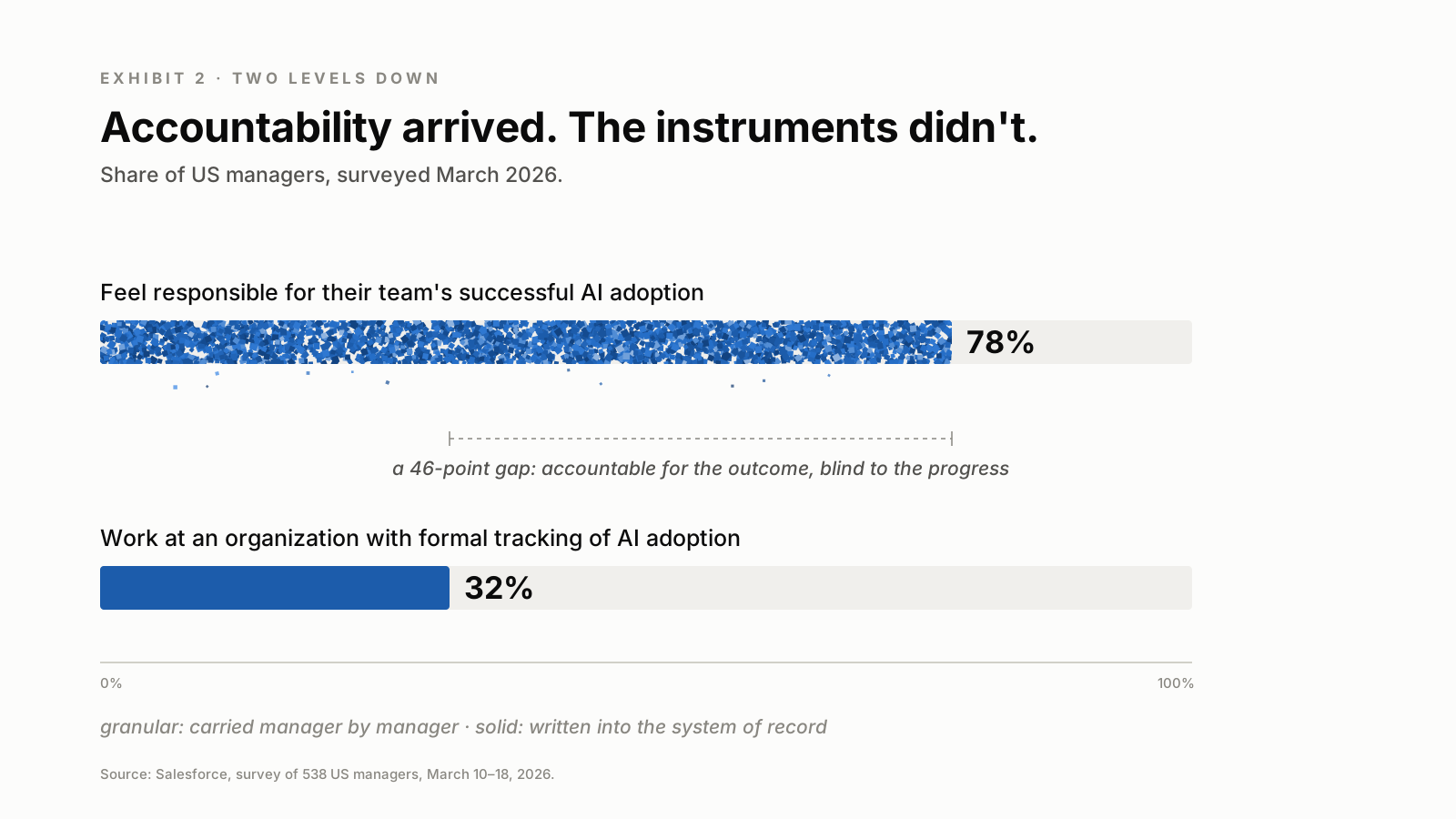
Close to the work, with authority: that describes a specific altitude. Two levels below the C-suite, a span is still wide enough to compose the fragments into a pattern, close enough to the work to verify the pattern against something real, and senior enough to act on what it shows. It is the one seat in the enterprise where the reported and lived organizations are both visible, which makes it the narrowest point through which AI's value must pass on its way to the income statement. The most recent management data suggests the responsibility has already landed there, without the tooling: in a Salesforce survey of 538 managers this spring, 78% said they feel responsible for their team's successful AI adoption, while only 32% work at an organization with formal tracking of it. Accountability for conversion arrived. The instruments and the authority did not.
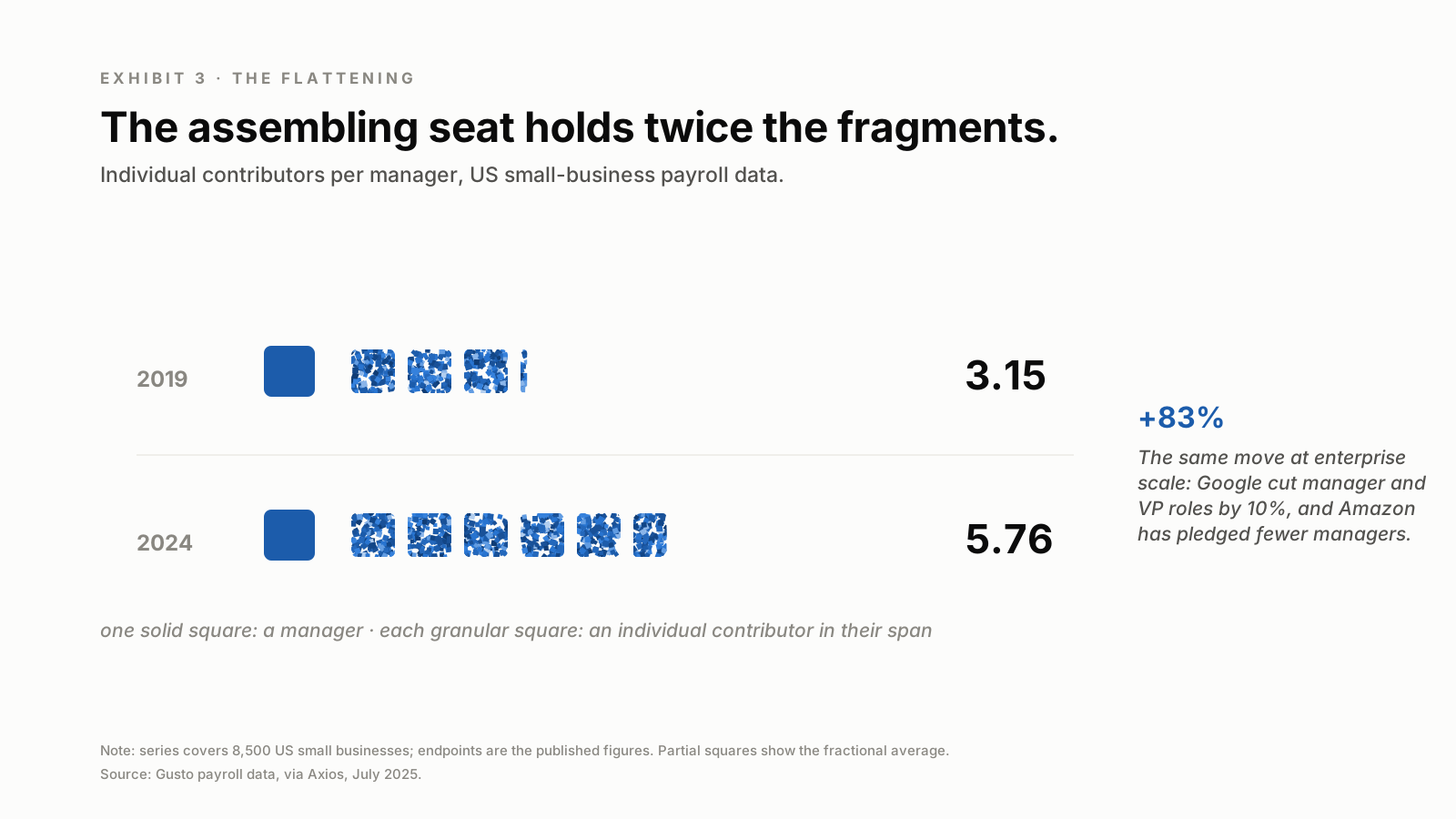
The prevailing org design is moving the other way. Manager spans have nearly doubled since 2019 as enterprises flatten, on the logic that when AI can summarize, the summarizers are overhead. Some of that removes real bureaucracy. But it also thins the one layer where an assembled record could meet allocation authority, in the same budget cycle the AI investment is supposed to pay off.
Which resolves the two camps this piece opened with. The deployment camp is right that the gains are real, and wrong that more deployment will surface them. The skeptic camp is right that the earnings are missing, and wrong about why. Enterprise AI is heading toward one of two endings: the most convincing false picture a company has ever produced of itself, or a reported organization that must reconcile, decision by decision, with a record assembled from the work itself. The technology supports both endings. The organization chart decides between them, and most organization charts are deciding by default, one flattening cycle at a time, without anyone framing it as the decision it is.
For a leadership team, the fork reduces to two questions that fit on a page. Where will the assembled record be governed, and by people the workforce trusts to use it for redesign rather than for surveillance? And does anyone with allocation authority still sit close enough to the work to act on what it shows? Neither question gets answered two levels down. Granting that layer its authority, and protecting the people who use it, is the one act in this story only the top of the enterprise can perform. Companies that do it have a path to the second ending. Companies that don't will keep buying better mirrors for the reported organization, and the reflection will keep improving right up until it matters.