Free, open source, for Claude Code
From the question to the board memo.
Strategic Agentic Architecture coordinates twenty-four skills to take a serious decision from framing to a sourced, stress-tested memo. It builds the fact base, tests real options, rebuilds the economics, attacks the case, and keeps every figure traceable. One person, start to finish.
- 96 markdown files
- No code to compile
- Apache 2.0
- Version 0.6.0
What is in it
Twenty-four skills. Four of them do the talking.
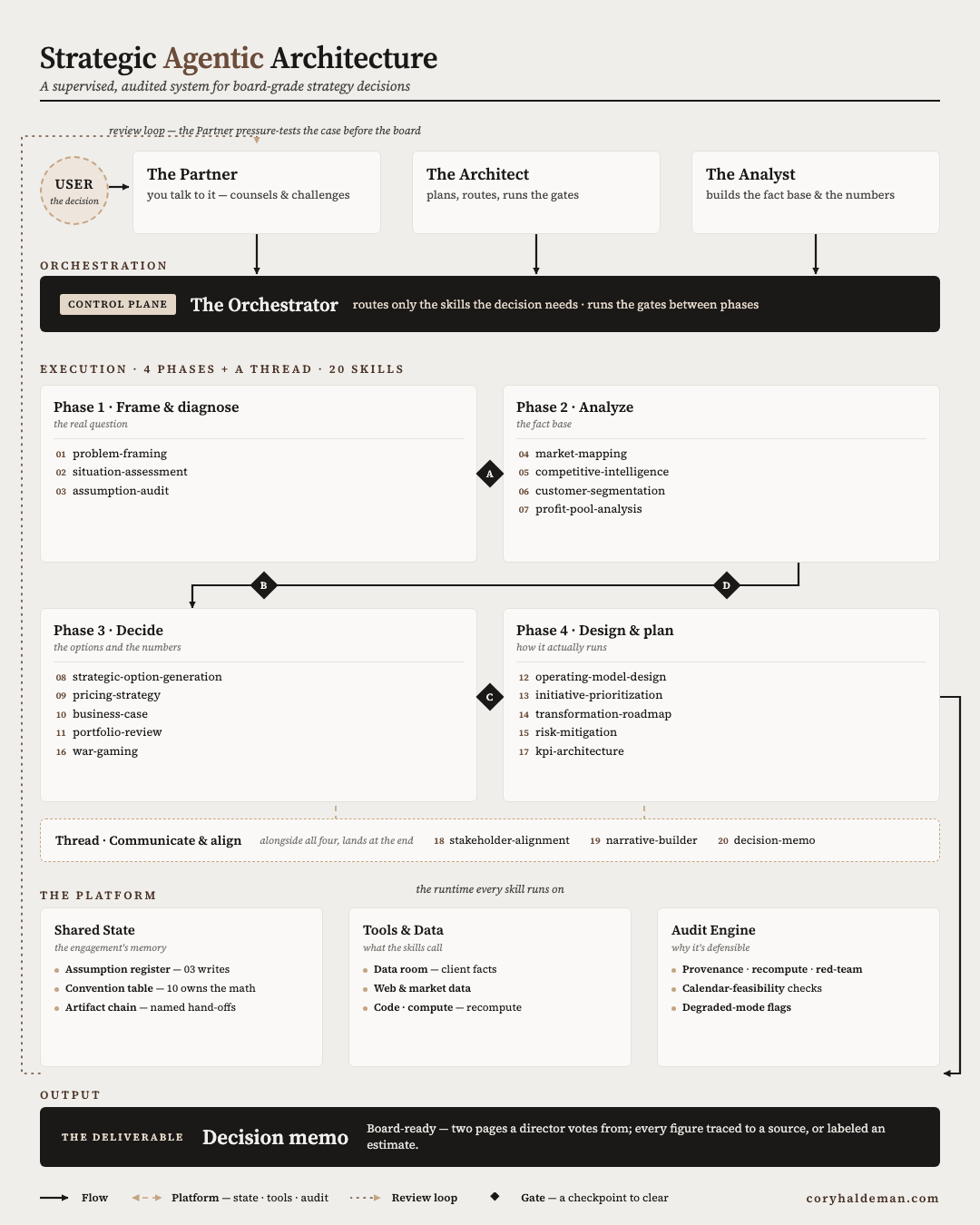
You talk to three of them. the-partner pushes back. the-architect plans the route and holds the gates. the-analyst builds the numbers. A fourth, the orchestrator, works out which of the rest your question actually needs, and leaves the others out.
The other twenty are the method. They run in four phases, Frame and diagnose, Analyze, Decide, Design and plan, with a communicate-and-align thread running alongside that lands at the end. Underneath sits shared state, the tools they call, and an audit engine that every phase has to clear.
Read the diagram left to right. The gates are the interesting part, because a gate can send the work backwards.
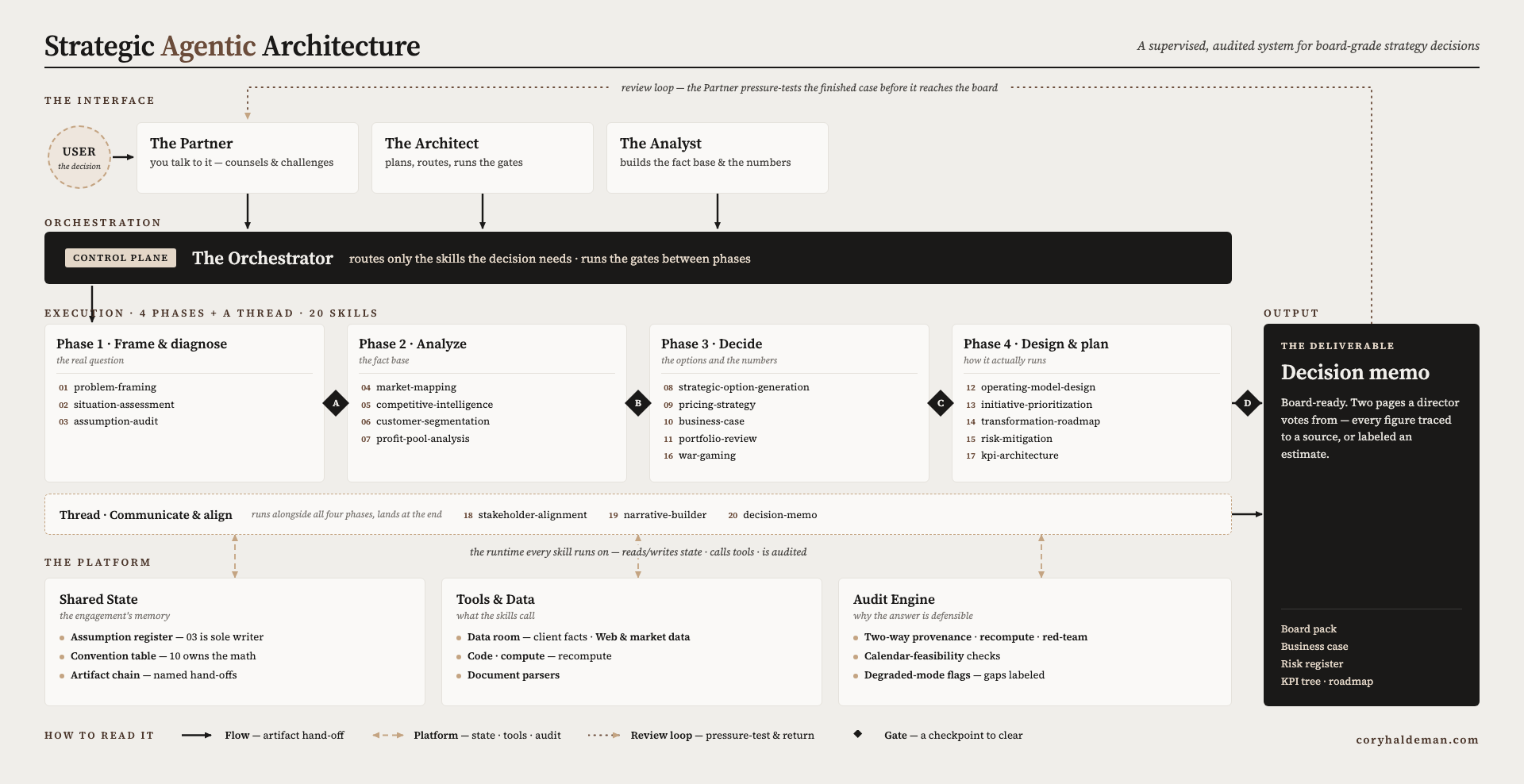
Wider than the screen. Scroll it sideways, or open it full size below.
What it produces
Blind constructed simulation. The company is invented.
It found $63M nobody had counted.
Blind means the system got the brief and nothing else, and was never told what the answer should be. The label rides along everywhere the number appears, this page included. A system that insists every figure gets sourced or labelled doesn't get a pass on its own marketing.
A one-pager put the acquisition at $60M. The run took the bridge apart line by line and found most of it was value the company would capture anyway, deal or no deal. Nobody had lied. It was clean arithmetic sitting on assumptions nobody had rebuilt in a year.
Then it found the bigger number. One turn of the exit multiple was worth about $63M, more than the entire acquisition was chasing, and it was sitting in the business already. The work moved to protecting it.
Six weeks of targeted work on the one fact that would settle it, and a trigger list for the moment it does.
Three catches on the way there are worth more than the verdict. The competitive read ran before options and economics, so the highest-swing fact landed first. A calendar check caught that the deciding data would arrive after the board had already voted, in time to do something about it. And three holes in the evidence came back flagged, each with a name attached to go close it, so you knew exactly what you were still carrying.
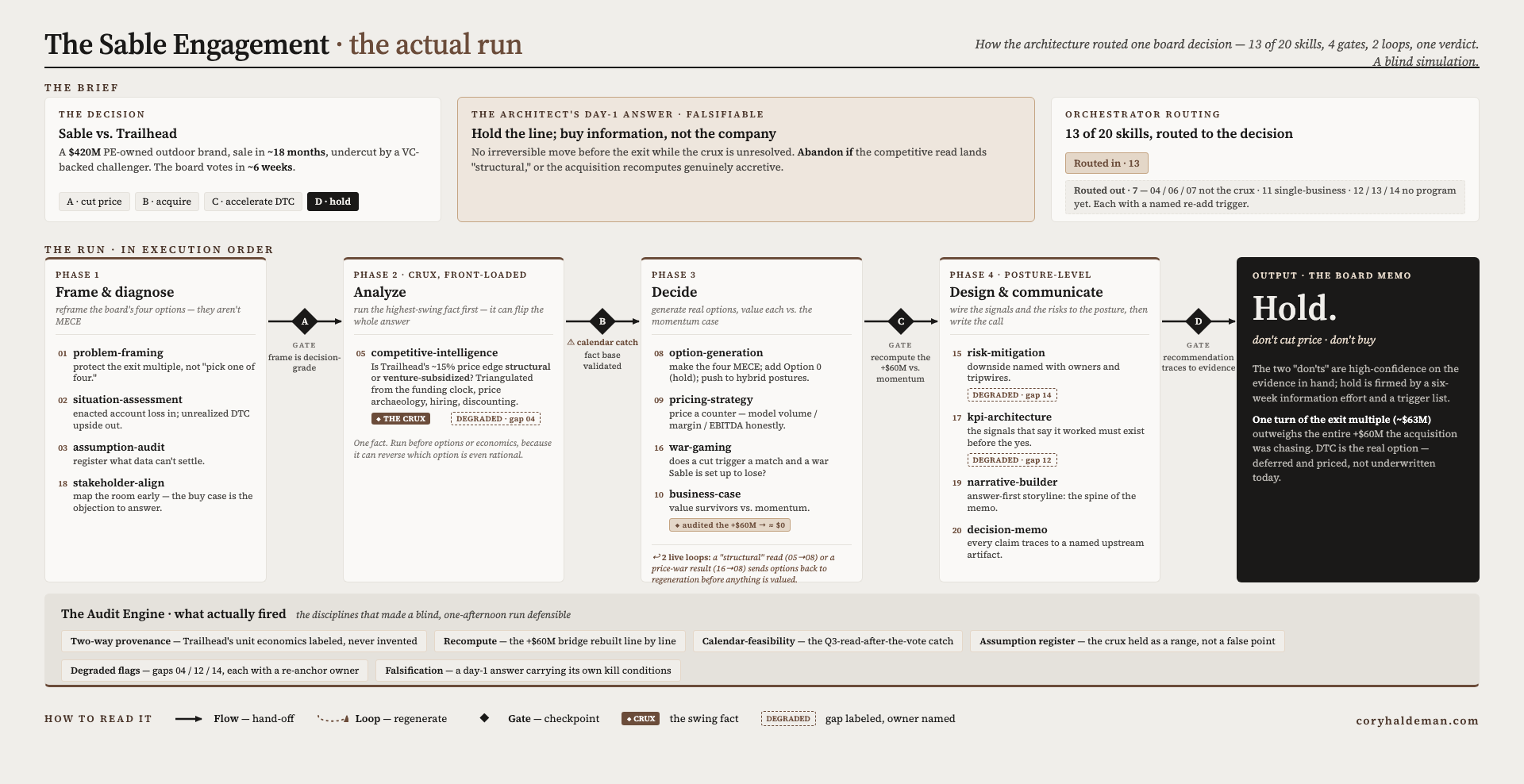
Wider than the screen. Scroll it sideways, or open it full size below.
How it works
Seven decisions, and what each one buys you.
These are not settings you flip. Each one is a deliberate choice about how the work gets done, and each one earns its place. The tradeoffs are listed alongside so you can judge whether it is the right trade for your context, and change it where it is not.
- Three roles, so you get counsel and computation
- An orchestrator that runs only what the question needs
- Gates between phases
- Every number traces both ways
- Every inherited number gets rebuilt
- Red-team at the handoff, while it is still cheap
- Gaps come back labelled, with an owner
Three roles, so you get counsel and computation.
- What it gets you
- Ask
the-partnersomething and it argues with you. Askthe-analystand it builds. Three separate postures, so the one you need is the one you get, instead of a single prompt drifting toward whatever you rewarded last turn. - What you trade for it
- You have to know who you're talking to. Send a question to the wrong role and you'll get a confident answer from something that wasn't built to give it.
An orchestrator that runs only what the question needs.
- What it gets you
- A route, not a survey. It picks the smallest set of skills that can answer your decision and tells you why it left the rest out. The fact that decides the answer gets run first, not nineteenth.
- What you trade for it
- Routing can be wrong, and a bad route hides better than a bad analysis does. Every skill it leaves out carries a named trigger to pull it back in, which helps without fixing it.
Gates between phases.
- What it gets you
- Mistakes caught while they're still cheap. A bad frame doesn't sit still, it makes everything downstream look sound while being wrong. A gate holds the phase until the artifact behind it stands up.
- What you trade for it
- Time, and going backwards. A gate that never fails is decoration, so a real one will sometimes throw out work you'd already finished.
Every number traces both ways.
- What it gets you
- Point at any figure and get its source. Not just where it ended up, but where it started: a filing, an interview, or an assumption somebody made on a Tuesday. When you get asked in the room, you have the answer.
- What you trade for it
- Bookkeeping on every claim, and some claims never graduate. A figure that can't be traced stays labelled an estimate, which is harder to put in a headline.
Every inherited number gets rebuilt.
- What it gets you
- The numbers you present are ones you own. Nothing gets to be load-bearing just because it was in the last deck. Take the bridge apart line by line and you find what the case actually rests on. This is the decision that turned up the $63M.
- What you trade for it
- It's slow, and it will take apart numbers you were attached to. Sometimes the one the whole case was built on, late enough that there's no comfortable way to say so.
Red-team at the handoff, while it is still cheap.
- What it gets you
- Criticism while changing your mind is still cheap. Attack a finished memo and the review becomes a defence, and the notes come back as wording. Attack the artifact at the hand-off and the case can still change shape.
- What you trade for it
- Rework, at the moment the work feels most fragile. And the reviewer shares the builder's context: each skill runs its checklist against its own output, so it's reliable on anything checkable, a figure with no source, an assumption that never made the register, arithmetic nobody rebuilt. It's weaker against a frame that's wrong, because the context that chose the frame is the one checking it. The genuinely independent review happened when the skills were written, not when your case runs.
Gaps come back labelled, with an owner.
- What it gets you
- You always know what you're still carrying. A missing number announces itself. A plausible invented one travels all the way to the board reading exactly like the real ones beside it. Every gap comes back flagged, with a name attached to go close it.
- What you trade for it
- The output has holes in it on purpose, and some readers will take that as weakness rather than as the system being straight about what it doesn't know.
Install
Install it.
You need Claude Code, Anthropic's terminal client, and permission to install on the machine you work on. Two commands, a few seconds.
-
Add the marketplace
/plugin marketplace add haldco-io/strategic-agentic-architecture -
Install the plugin
/plugin install strategic-agentic-architecture@haldeman
Claude confirms twenty-four skills. Then start anywhere. Describe the decision in plain language:
Use the-partner. I need to think through a decision.
To update: /plugin update strategic-agentic-architecture@haldeman. To remove it: /plugin uninstall strategic-agentic-architecture. Nothing is left behind either way.
It's 96 markdown files. No code, nothing to compile, nothing that phones home. Open a skill, rewrite it, throw it out. Version 0.6.0, which is the honest number: it works and it's still moving. Want to look first? Read every file on GitHub, or take the zip, 913 KB.
What I can and cannot see. The plugin itself makes no network calls: it is markdown, and it sends nothing anywhere. I see that a marketplace was added, and nothing about what you run through it. Claude Code is a separate matter and talks to Anthropic under Anthropic's terms, which is worth knowing if your work is sensitive.
Yours to change
Make it yours.
This is a starting point, not a finished product. It's all plain text. If a phase doesn't match how decisions actually get made where you work, rewrite it. If a skill is dead weight, delete it. The gates are the likeliest thing to be wrong for you, because a gate encodes a standard and standards are local. Apache 2.0, so fork it, sell work built on it, never mention me.
Three places where you are the difference, and no amount of editing changes that.
- You read the room. Tell it who is in one and it will map them. Knowing which objection is really about the analysis, and which is about last year's reorg, is your read to make.
- You bring the proprietary picture. It works from what you give it and what is public. Everything your firm knows that the internet does not is the part that usually decides things, and that comes from you.
- You carry it in. It makes a case traceable enough to survive the questions. You are the one answering them, which is why every figure comes with the source attached.
Run it on something real and I want to hear where it broke. Open an issue: what you were deciding, which gate let it through. Nothing to sign up for, and the thread stays public so the next person gets the benefit.
Related reading
Where this came from.
Two pieces that explain why it is shaped this way.
Are middle managers the key to AI transformation?
The layer being cut is the only one close enough to the work to lead the change the CEO is announcing.
One Technology, Two Companies
Why enterprise AI ends as either the most convincing false picture a company has ever produced of itself, or the first record that can argue back.